


The Georgian Dream's State Security Service (SSSG) announced the conclusion of its investigation into the possible use of bromobenzyl cyanide, known as “camite,” to disperse anti-government demonstrations in November-December 2024. According to Lasha Maghradze, the first deputy head of the State Security Service, the Georgian Ministry of Internal Affairs (MIA) has never purchased “camite.”
News



At today’s briefing (December 6), Maghradze said that during the demonstrations on December 4-5, 2024, the police used “chlorobenzylidene malononitrile” and its solvent “propylene glycol,” which were imported into Georgia in 2007 and 2009. He added that “none of these substances are prohibited.” However, Maghradze did not clarify which substances were used on the other protest days after 28 November.
Chlorobenzylidenemalononitrile is also known as CS gas, or tear gas.
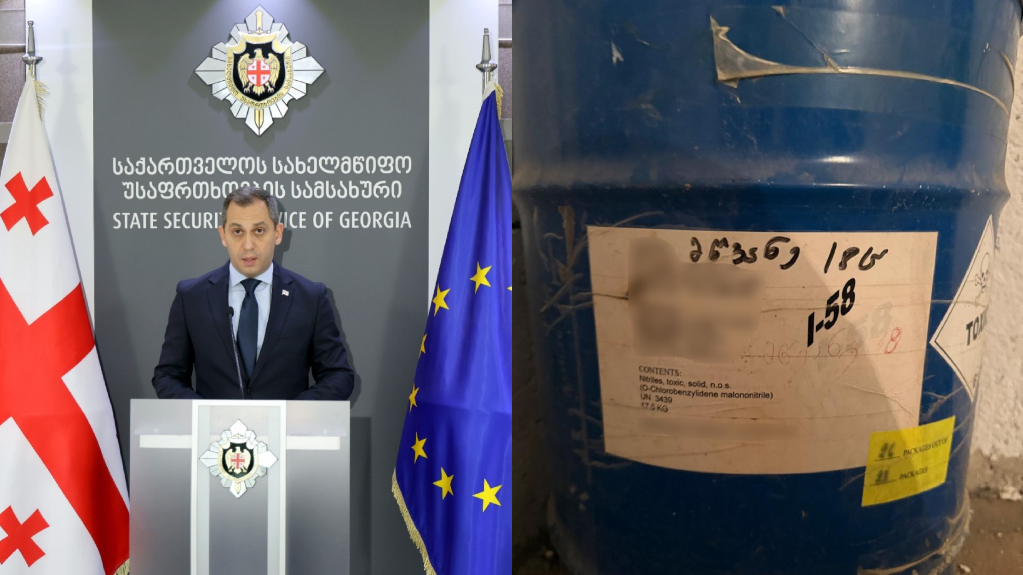
The substance mentioned, [“chlorobenzylidene malononitrile”], was purchased by the Ministry of Internal Affairs from a Jewish company on 18 December 2007 and 27 March 2009, together with the solvent substance “trichloroethylene”. During transportation, it was assigned the international shipping code UN3439, while the solvent was given UN1710. These codes are recorded in customs documentation and in all others, including write-off acts, created after their use. A 17.5-kilogram barrel containing the powder was sampled. “An information sticker made by the organisation supplying the substance is attached to it, which, along with a lot of other data, indicates the name of the substance, “chlorobenzylidine malononitrile”, and the transportation code UN3439, is attached to the barrel,” Maghradze explained.
According to him, the investigation seized 25 research samples from the databases of the First and Second Divisions of the Special Tasks Department of the Ministry of Internal Affairs. Chemical examination was conducted at the Levan Samkharauli National Forensic Bureau. As Lasha Maghradze said, according to the examination, the seized substances are:
- Chemical substance “chlorobenzylidine malononitrile”
- Chemical substance “trichloroethylene” - this concerns a written-off balance amounting to 880 liters.
- The chemical substance “propylene glycol”.
“It was found that in early December 2024, specifically on the night of December 4-5, the substance “chlorobenzylidene malononitrile” was used to control crowds, and “propylene glycol” was used as a solvent. None of the above substances belong to the category of prohibited substances,” said Lasha Maghradze.
The SSSG investigation reveals that, under the codes UN3439 and UN1710 mentioned in the BBC journalistic report, multiple Georgian organisations- including Aversi-Rational, GPS, Rustavi Azot, and others- have imported various civilian, industrial, and medical cargo a total of 606 times over the last 20 years, along with the Ministry of Internal Affairs.
“Transportation code UN3439 – 507 times and transportation code UN1710 – 99 times are recorded in the accounting databases of the Customs Department. “
“As for the substance “bromobenzyl cyanide”, also known as “camite”, the Georgian Ministry of Internal Affairs has never purchased such a substance,” noted the First Deputy Head of the State Security Service.
Five days ago, on December 1, the State Security Service of Georgia began an investigation into the BBC's journalistic report, citing Articles 333 and 319 of the Criminal Code. These relate to abuse of official authority and assistance to a foreign organisation in hostile activities. According to Lasha Maghradze, “more than 160 investigative actions were carried out, and 93 witnesses were interviewed. These included current and former employees of the Ministry of Internal Affairs, doctors, experts, people mentioned in the BBC report, NGO representatives, and others. “
“Witnesses in the case were interviewed, specifically those individuals whose so-called conclusions or information were relied upon in the BBC-reported information regarding the use of a poisonous chemical substance. During the interrogation, all of them denied that their information or conclusions were about the poisonous chemical substance “camite.”
According to the authors of the so-called study, they could not determine the use of “camite” because their research did not cover that area.
Representatives from the medical and expert communities were also interviewed as part of the investigation. Additionally, based on information from open sources, we can clarify that the use of the substance “bromobenzyl cyanide”, known as “camite”, against humans results in extremely serious and often even fatal consequences. This is the reason it was banned in the modern civilised world in the 1930s.
According to documents from the Ministry of Health of Georgia obtained in the days after 28 November 2024, five of the 54 individuals taken to hospital facilities by emergency medical teams experienced mild intoxication and were discharged the following day.
[...] of the persons of interest to the investigation, only the interrogation of one witness, Lasha Shergelashvili, could not be carried out. The views of the author of the BBC's report were significantly based on his information," stated Lasha Maghradze.
The briefing revealed that the SSSG is conducting “operational-search and investigative actions” against Lasha Shergelashvili, a former senior official of the MIA's Special Tasks Department. The case concerns the “weapon found in the forest” incident that occurred before the October 4 demonstration. The SSSG has filed charges in absentia against Beka Chulukhadze in this case.
“The investigation is actively working on the version that suggests Lasha Shergelashvili, a contract employee of the Ukrainian special services, instructed Beka Chulukhadze to buy and conceal the mentioned ammunition, explosives, and devices near Tbilisi shortly before October 4. Shergelashvili is currently in Ukraine.“
Thus, the undeniable evidence gathered by the investigation concludes that the information presented in the BBC film about the use of the so-called chemical weapon “camite” against demonstrators in Georgia is completely false and deliberately misleading. It seeks to damage Georgia's interests and, unfortunately, involves some Georgian citizens as well. In addition to the authors of the BBC film, their actions seem to be part of a well-planned, organised campaign aimed at achieving specific hostile objectives against Georgia.
Accordingly, since the investigative actions related to one of the two directions- specifically the alleged fabrication of the claim that the police used the banned substance known as “camite” in the 1930s- have been completed, the State Security Service is continuing the investigation into the remaining potential crime. This crime falls under Article 319 of the Criminal Code of Georgia and concerns assisting a foreign organisation in hostile activities,” said the First Deputy Head of the SSSG.