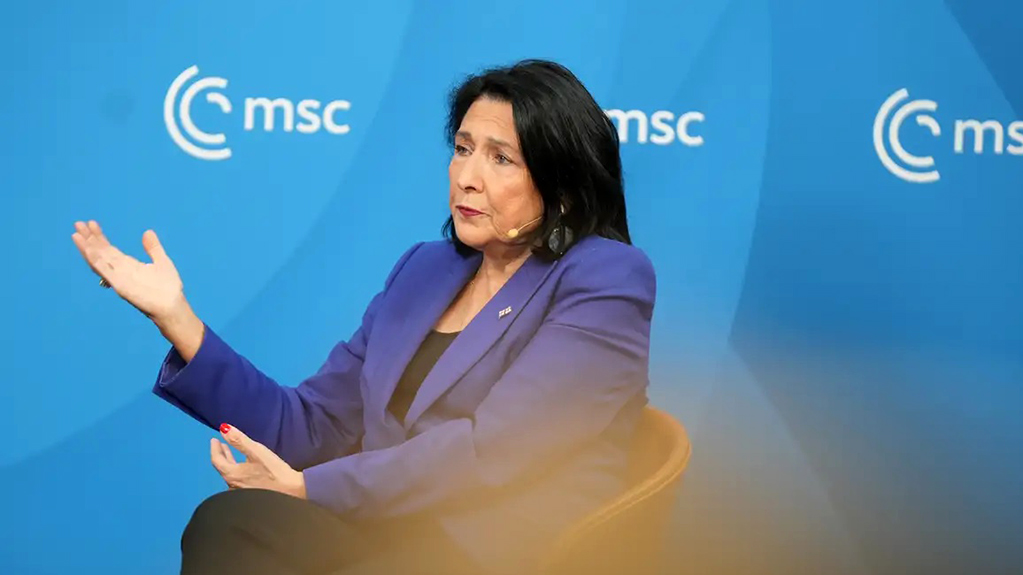
Georgia’s fifth President, Salome Zurabishvili, addressed the Organisation for the Prohibition of Chemical Weapons, the United Nations and the Council of Europe to investigate the possible use of a World War I-era chemical weapon to disperse anti-governmental demonstrations in November-December 2024.
News



In the letter dated December 2, Salome Zurabishvili notes that during 2025, reliable sources, including local human rights organisations, international media and independent monitoring bodies, have documented patterns of excessive use of force against peaceful demonstrators, arbitrary detention of activists, restrictions on freedom of expression and assembly, and harassment of journalists and civil society actors.
“Of particular note is the report from November-December 2024, which indicates that Georgian law enforcement authorities may have employed chemical agents, potentially bromobenzyl cyanide, in conjunction with high-pressure water cannon systems to disperse peaceful protests, as documented in an investigative report by the British Broadcasting Corporation (BBC) dated 1 December 2025.
Despite repeated requests from healthcare professionals, civil society groups, and human rights defenders, there has been no transparent disclosure regarding the chemical composition of the substances used, nor has any impartial investigation been undertaken.
Should the reports concerning the potential use of highly toxic chemical compounds be substantiated, such actions would constitute a serious violation of human rights and international human rights treaties to which Georgia is a party,” it is stated in the letter, addressed to H.E. Ambassador Fernando Arias, Director-General of the Organisation for the Prohibition of Chemical Weapons (OPCW), Volker Turk, UN High Commissioner for Human Rights, and Michael O'Flaherty, Commissioner for Human Rights of the Council of Europe.
Salome Zurabishvili, “considering the gravity of these concerns,” she urged international organisations to “undertake a thorough and impartial investigation into the reported human rights violations, including the possible use of chemical agents against peaceful demonstrators.”
The fifth President notes that an independent and comprehensive assessment is essential to ensure compliance with international human rights standards.
The BBC gathered evidence suggesting that in 2024, the Georgian Dream party used WWI-era chemical weapons to disperse protests. The substance involved is bromobenzyl cyanide, which the French military called “camite.” The BBC investigative journalists obtained a copy of the Special Tasks Department's inventory, dated December 2019. Journalists discovered it contained two unnamed chemicals. These were listed as "Chemical liquid UN1710" and "Chemical powder UN3439", along with instructions for how they should be mixed.
According to the BBC, UN1710 stands for trichloroethylene (TCE), which allows other chemical compounds to dissolve in water. Christopher Holstege, Chief of Division of Medical Toxicology at the University of Virginia, explains that “Trichloroethylene easily penetrates the skin, lungs, and gastrointestinal tract. It impacts the nervous and cardiovascular systems, and it can also affect the liver.”
UN3439 was much harder to identify, as the BBC claims. It is an umbrella code for a whole range of industrial chemicals, all of which are hazardous. The only one of these that the BBC found to have ever been used as a riot-control agent is bromobenzyl cyanide.
“Based on the available evidence… the clinical findings reported by both those exposed and by other witnesses are consistent with bromobenzyl cyanide," said chemical weapons expert Christopher Holstege, and ruled out the likelihood of the symptoms being caused by more conventional crowd control measures, such as tear gas. According to the expert, the duration of the symptoms was not consistent with the effects of tear gas.
Today, Georgian Dream Minister of Internal Affairs Gela (Geka) Geladze announced that the accusation that the Ministry of Internal Affairs (MIA) used prohibited substances, so-called “camite” against demonstrators, is entirely absurd, a lie, and does not correspond to the truth. Moreover, he stated that MIA has never purchased the so-called “camite”. With this statement, he rejected the claim of his predecessor, Vakhtang Gomelauri, that the substances named by the BBC, “the Ministry of Internal Affairs (MIA) indeed purchased and used, but only until 2012.”