



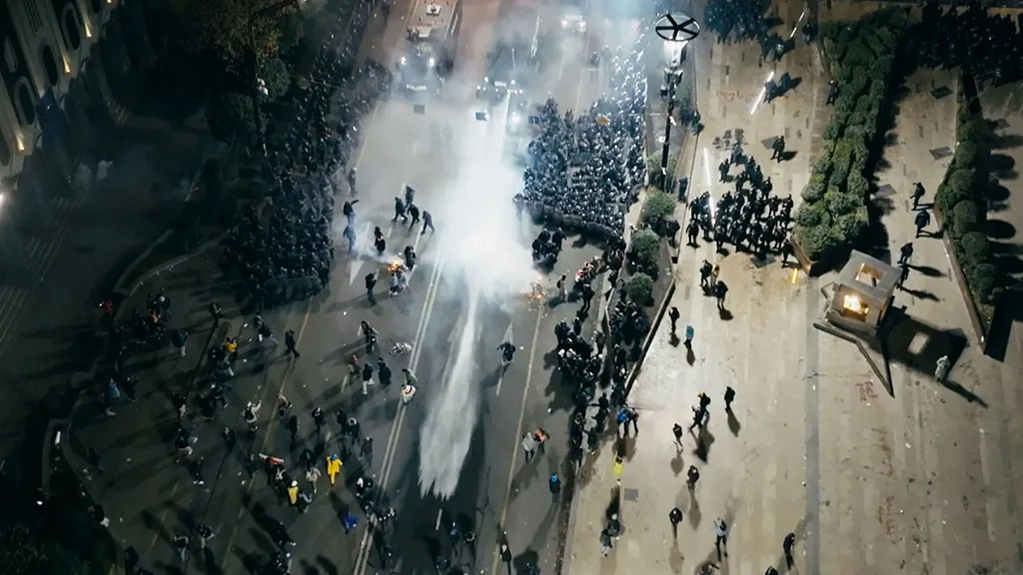
In late 2024, the Georgian Dream government employed chemical weapons from World War I to suppress anti-government protests in Tbilisi, the BBC reports, citing collected evidence.
News






One demonstrator told the BBC about the water cannon used against him and other protesters, saying that it felt like the water was burning him and that it was impossible to get rid of the sensation even by washing.
Demonstrators were protesting the suspension of Georgia's EU accession talks, and also reported experiencing symptoms such as shortness of breath, coughing, and vomiting that had lasted for weeks.
The BBC spoke to chemical weapons experts, representatives of the Georgian police special forces, and doctors, gathering evidence that indicates the use of bromobenzyl cyanide.
the French military named this agent "camite“. It was created by the Triple Entente (an alliance of Great Britain, France, and Russia) for deployment in World War I.
“Camite was deployed by France against Germany during World War One. There is little documentation of its subsequent use, but it is believed to have been taken out of circulation at some point in the 1930s, because of concerns about its long-lasting effects. CS gas - often referred to as "tear gas" - was used as a replacement, the BBC article states.
The BBC was assisted by several senior officials from the Georgian Interior Ministry's special forces unit in identifying the chemical. Lasha Shergelashvili, who was previously responsible for arming the unit, believes it is the same compound he was tasked with testing in a water cannon in 2009. He mentioned that the substance's effect on him was unprecedented. After standing near the spray site, he struggled to breathe, and he, along with 15-20 colleagues who tested the substance, found it difficult to wash off.
"We noticed that the effect was not wearing off, as is the case for [regular] tear gas. Even after we washed our faces with water, and then with a special solution of baking soda and water, which was prepared in advance, we still couldn't breathe freely,” says Shergelashvili.
He says that, based on the test results, he recommended discontinuing the chemical. However, he says that the water cannon vehicles were nevertheless loaded with it - and that this remained the case at least up until 2022, when he quit his job and left the country.
Shergelashvili, currently residing in Ukraine, told the BBC that after viewing reports of last year's protests, he quickly suspected the demonstrators had encountered the same chemical. This was later confirmed by colleagues with whom he remains in contact, all of whom continue to hold their positions.
When he was asked whether the product he tested could have been CS gas, which irritates the eyes, skin, and respiratory system but only temporarily, he said it appeared to be far stronger than that.
"I cannot name an example or compare it with anything [else]," he said, adding it was "probably 10 times" stronger than more conventional riot-control agents.
Mr Shergelashvili does not know the name of the chemical he was asked to test. But the BBC managed to obtain a copy of the inventory of the Special Tasks Department, dated December 2019. Journalists discovered it contained two unnamed chemicals. These were listed as "Chemical liquid UN1710" and "Chemical powder UN3439", along with instructions for how they should be mixed.
The BBC showed the inventory list to another former high-ranking police officer from the riot police, who confirmed it was authentic. He identified the two unnamed chemicals as those likely to have been added to the water cannon.
It was easy for journalists to identify UN1710 because it enables other chemicals to dissolve in water. We then had to work out which chemical it helped dissolve.
As the BBC writes, UN3439 was much harder to identify because it is an umbrella code for a range of industrial chemicals, all hazardous. The only one of these that the BBC found to have ever been used as a riot-control agent is bromobenzyl cyanide.
The BBC writes that the Georgian authorities called the investigation's findings "absurd" and said that the police had acted legally in response to the "illegal actions of brutal criminals".
The Georgian Ministry of Internal Affairs used various means to disperse the protesters, including water cannon, pepper spray, and tear gas.
Paediatrician Konstantine Chakhunashvili, who has participated in demonstrations and was sprayed by water cannons, told the BBC that his skin “burned” for several days and that this sensation could not be washed away with water. Moreover, he said, the condition worsened when he tried to wash his face. Chakhunashvili surveyed social media and asked protest participants who had also come into contact with emergency vehicles to participate. About 350 people responded, of whom almost half said they had developed one or more side effects over 30 days. Symptoms included headaches, fatigue, cough, shortness of breath and vomiting.
Konstantine Chakhunashvili's study, accepted for publication in the international journal Toxicology Reports, examined 69 people and found a "significantly higher prevalence of abnormalities" in the electrical signals in the heart.
Chakhunashvili's research, as the BBC notes, confirmed the conclusion made by local journalists, doctors, and civil rights organisations that “the water cannon must have been laced with a chemical.”
The BBC asked Professor Christopher Holstege, a world leading toxicology and chemical weapons expert, to assess whether their evidence pointed to camite being the likely agent used. Based on the results of Dr Chakhunashvili's study, victim testimony, the riot police inventory, and Mr Shergelashvili's account of the chemical tests, Prof Holstege believes that this is the case.
"Based on the available evidence… the clinical findings reported by both those exposed and by other witnesses are consistent with bromobenzyl cyanide," said Christopher Holstege, and ruled out the likelihood of the symptoms being caused by more conventional crowd control measures, such as tear gas. He said the duration of the symptoms was not consistent with the effects of tear gas.
"I've never seen camite being utilised in modern society. Camite is markedly irritating and persistent with its irritation," the expert said.
Christopher Holstig suggested that bromobenzyl cyanide might have been used because it is a strong deterrent:
"It would keep people away for a long time. They couldn't decontaminate [themselves]. They would have to go to the hospital. They would have to leave the area. If that is indeed the case - that this chemical has been brought back - that is actually exceedingly dangerous."
The BBC writes that after World War I, American police briefly used "camite" as a means of riot control, but abandoned its use after the invention of safer alternatives, such as tear gas.
Under international law, police forces may use chemicals as crowd-control agents, provided they are considered proportionate and have only short-term effects. Experts interviewed by the BBC said that since there are safer and more conventional riot-control agents available to police, an obsolete and more potent agent could be classed as a chemical weapon.
UN Special Rapporteur on Torture, Alice Edwards, said the BBC's findings were disturbing. Earlier this year, she and other independent UN experts urged the Georgian government to investigate claims of excessive force and torture by law enforcement during protests in November-December 2024.
Edwards believes that the lack of strict regulation of the use of chemicals in water cannons is a problem that needs to be addressed: “It does lead me to consider [this practice] as an experimental weapon. And populations should never be subjected to experiments. This is absolutely in violation of human rights law.”
UN Special Rapporteur on Torture stressed that any effect of a riot control measure should be temporary under international law, and that the symptoms described "are beyond what would be considered temporary and acceptable.
“So, all of those cases should be investigated, including under the rubric of torture or other ill-treatment,” said Alice Edwards.